


 Previous Article
Next Article

 Previous Article
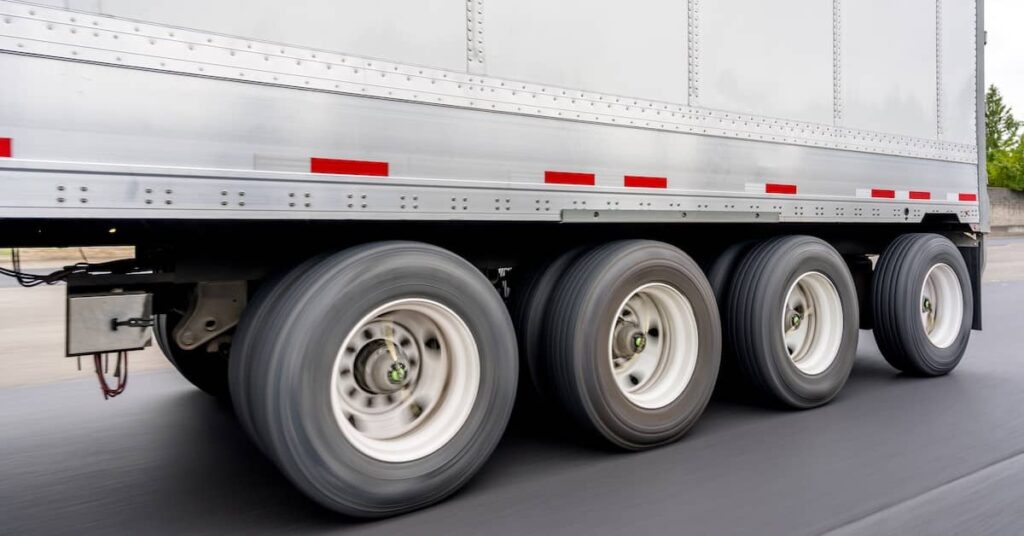


Semi-trucks are among the heaviest vehicles on the road, which also makes them among the most dangerous. As such, semi truck weight limits are tightly regulated to protect both public safety and our infrastructure.
Generally, a fully loaded tractor-trailer operating on an interstate highway is allowed to weigh up to 80,000 pounds. This includes the tractor, trailer, cargo, and fuel. When empty, these trucks can still weigh over 30,000 pounds depending on the specific type of trailer.
As trucks push close to – or even beyond – the 80,000-pound limit, the dangers associated with their excessive weight increases. Truck drivers, trucking companies, and all other parties responsible for adhering to the semi truck weight limit must be held accountable when violations lead to a serious accident.
If you have been injured in a truck accident and believe it was due to excessive weight, contact the Arizona truck accident attorneys at Burg Simpson as soon as possible at 602-777-7000. During your FREE and confidential case evaluation, our lawyers will review the details of your claim to determine how to best protect your rights.
Semi-truck weight limits are governed at the federal level by the U.S. Department of Transportation (DOT) through the Federal Highway Administration (FHWA). The current weight limits are as follows:
These guidelines have been in place since 1975 under the Bridge Formula, which helps calculate how much weight is safe for trucks crossing bridges on the interstate highway system. The Arizona Department of Transportation (ADOT) enforces these same regulations on state highways. Drivers and carriers that need to transport heavier loads must apply for an oversize/overweight permit.
The maximum load weight for a semi-truck depends on the empty weight (also referred to as the “tare weight”) of the truck, which typically ranges from 20,000 to 35,000 pounds.
It is also important to keep other factors in mind, such as axle configuration, number of tires, and the spacing between axles. Even if a loaded truck is below the 80,000-pound threshold, that does not necessarily mean it is compliant.
An overweight load is any load that causes a truck to:
Load violations can also be applied for imbalance or shifting loads, or for inaccurate weight declarations. Trucks not carrying valid permits or failing to operate with proper authorization can also result in fines and penalties.
Penalties for an overweight truck include civil fines enforced by the Federal Motor Carrier Safety Administration (FMCSA) and state agencies such as ADOT. These fines can reach thousands of dollars per offense, and may be in addition to state fines in Arizona that are calculated based on the number of pounds over the limit a truck’s GVW is.
Drivers may also face vehicle impoundment and the suspension of commercial driving privileges, especially in cases involving repeat offenses or operating without appropriate permits.
However, the greatest risk for trucking companies, drivers, and other entities is the potential for insurance claims and litigation that can arise if an accident is caused by an overweight truck.
Defendants may be held liable for damages resulting from their negligence through a civil liability claim. In some cases, these damages can add up to hundreds of thousands – or even millions – of dollars.
Potential damages in a truck accident claim include:
Excess weight can contribute to truck accidents in a few key ways:
It can be difficult to determine with certainty that excessive weight caused or contributed to the accident. Oftentimes, investigators and accident reconstruction specialists are called upon to review the evidence and help determine whether or not the overloading contributed to the crash.
There are several different parties who can be responsible for an overloaded truck. Your claim may involve multiple defendants, including:
Each of these parties has some responsibility for monitoring cargo weights and ensuring compliance with federal and state regulations. Determining the degree of responsibility often comes down to key pieces of evidence such as:
A thorough investigation is one of the most critical steps when preparing a truck accident claim. Without clear evidence, it will be difficult to recover fair compensation for your losses.
This is the key question you will need to be able to answer, which can be proven through weigh station tickets, on-board scale data, inspection reports, and more. You will also need to prove that the excessive weight contributed to the accident.
Ultimately, the need for strong evidence and a full investigation is why truck accident victims should begin protecting their rights as soon as possible. The longer you wait, the harder it will be to preserve and gather evidence that helps to establish negligence.
At Burg Simpson, our truck accident attorneys have decades of experience handling complex cases that involve federal and state trucking regulations.
We work with mechanical and reconstruction experts to uncover violations of FMCSA or ADOT regulations that may have contributed to an accident, doing everything in our power to ensure our clients are able to recover the compensation they need and deserve.
While every case is unique, we bring the knowledge, determination, and resources needed to protect your rights.
If you or a loved one has been injured in a collision with an overloaded semi-truck, contact Burg Simpson by calling 602-777-7000 today. Your initial consultation is FREE, and you do not have to pay legal fees until we obtain a favorable result on your behalf. Our truck accident lawyers are proud to represent clients in Phoenix, Tucson, Sedona, and throughout Arizona.