


 Previous Article
Next Article

 Previous Article


Yes, it is in your best interest to get medical care after a car accident. The symptoms of serious brain injuries, spinal cord injuries, and internal trauma may not be significant until later, and by then these issues could be life-threatening.
Generally, it is best to call the police from the scene of the accident rather than reporting it later. This is especially the case if the crash meets the “duty to report” found in Colorado Revised Statutes § 42-4-1606.
Drivers in Colorado must notify law enforcement immediately if they are involved in an accident that results in:
Calling the police at the scene ensures that all evidence is available and the officer can conduct a complete investigation. This increases the likelihood of the crash report capturing important details that may enhance your claim against the other driver.
Most auto insurance policies include a provision about reporting the accident “promptly” or “immediately.” In practice, this is generally held to be within 24–72 hours of the collision.
Waiting too long to report the crash may raise suspicions and increase the risk of your claim being denied. Check your insurance policy and contact Burg Simpson if you have any questions. Our firm has been taking on insurance companies for 50 years.
Yes, you need to prove the other driver was at fault to recover compensation for a car accident in Colorado. Under Colorado’s modified comparative negligence law (C.R.S. § 13-21-111), you can make a claim against the other driver as long as your share of fault is less than theirs.
If you are 50% or more responsible for the crash, you are barred from recovering compensation. The insurance company may try to put the blame on you, in which case you need a skilled car accident lawyer who can present evidence of the other driver’s negligence.
If the other driver has no insurance (uninsured) or their insurance does not fully cover your losses (underinsured), you may be able to make a claim through your uninsured/underinsured motorist insurance (UM/UIM). Colorado law does not require UM/UIM insurance, but it is coverage worth having.
Approximately 19.7% of drivers in Colorado are uninsured. UM/UIM coverage can provide you with financial protection if the other driver does not have coverage to pay for your losses.
You need to prove the other driver was at fault to seek compensation through UM/UIM. Attorneys at Burg Simpson can collect evidence and help you make a claim under your own insurance policy.
You are not alone if you are wondering what to do after a car accident. The steps you take in the minutes, hours, and days after the crash can have serious repercussions for your health and your ability to make a claim for compensation.
A Denver car accident attorney at Burg Simpson can help you protect your rights. We offer FREE case evaluations and 50 years of experience representing people who have been injured in motor vehicle collisions.
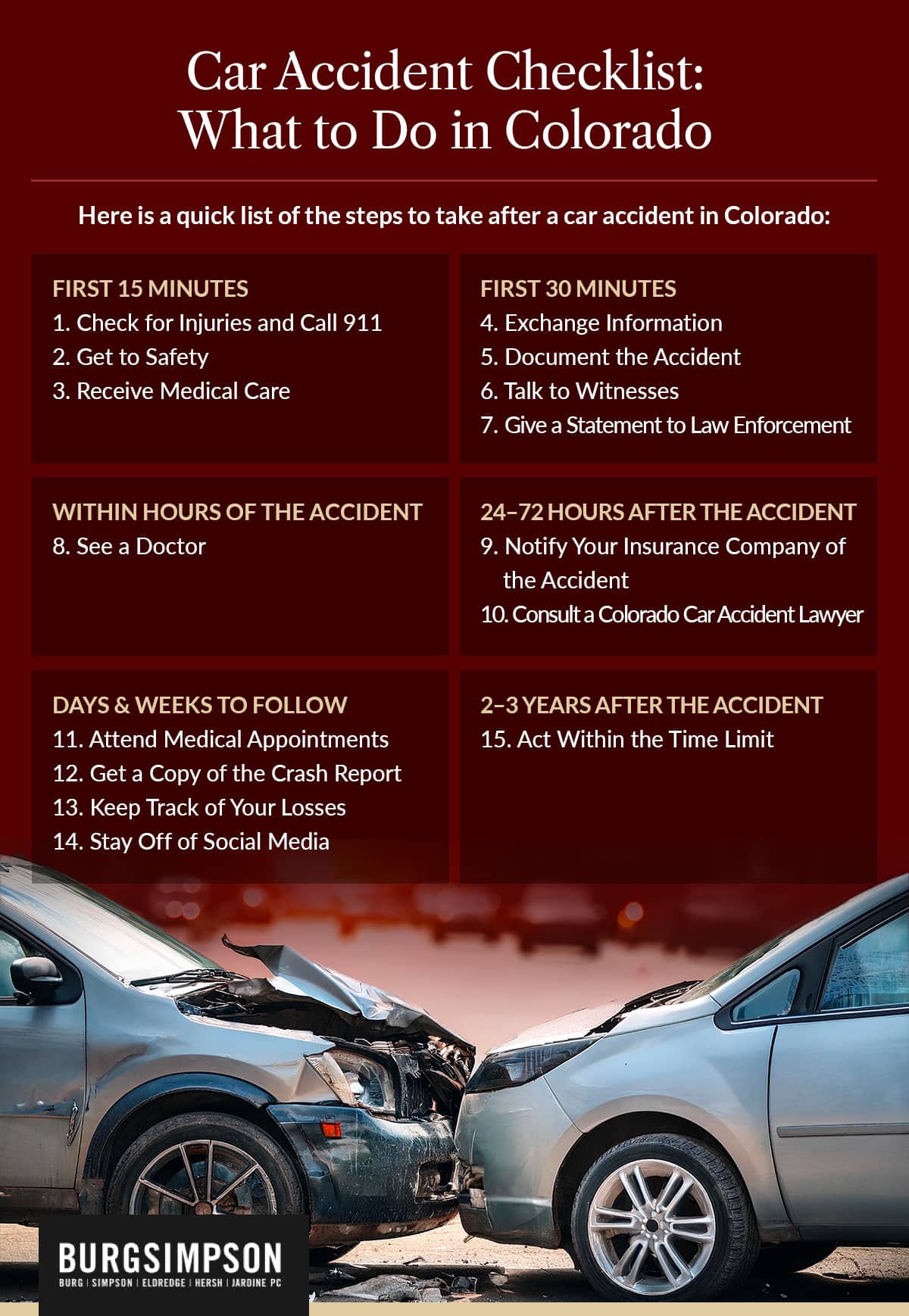
Here is a quick list of the steps to take after a car accident in Colorado:
We discuss each of these steps in detail below. If you do not know what to do after a car accident and need immediate help, call Burg Simpson at 303-792-5595.
The first thing you need to do is check yourself and any passengers inside your vehicle for injuries. If you or anyone else is hurt, dial 911 immediately.
Safety should be your top priority after a car accident. Reporting the accident to the authorities ensures that first responders will arrive on site to help the victims, as well as enabling law enforcement to investigate the crash.
At minimum, you should get to the shoulder of the road and out of the path of traffic. If possible, you should try to move your vehicle out of harm’s way. This is especially important on busy roads like I-70, I-25, and 6th Avenue.
Moving your vehicle can prevent secondary collisions, but you need to be able to operate the vehicle safely. Extreme damage or severe injury can impact your ability to drive, in which case the safer choice may be to turn on your hazard lights and leave the vehicle where it is.
First responders can assess your injuries and provide basic aid, but you may need more comprehensive evaluation and treatment. If you sustain a serious or catastrophic injury, you should go to the emergency room as soon as possible.
Accident victims in Denver are often taken to facilities such as:
If it is safe for you to remain at the scene after being checked out by paramedics, we recommend continuing with the following steps. Otherwise, you should stop here and get to an emergency room as soon as possible.
You need to be able to identify all of the drivers involved in the crash. Get the following information from each driver before you leave the scene:
When speaking with the other driver, be careful not to admit fault or apologize. You can ask if they are okay, but otherwise you should focus on getting the details above from every driver who played a role in the wreck.
First, note where the accident occurred. This includes the name of the street, the intersection, or the highway mile marker. You should also note the approximate time.
Next, use your phone to take pictures of the following details:
Witnesses can help corroborate key details. Ask for their names, contact information, and what they saw. Record or write down what they say so you have a record of their testimony.
Finally, you should make notes of what you were doing just prior to the accident, as well as any information shared by the other driver(s). This can help with determining fault for car accidents, as well as identifying potential vulnerabilities in your case.
In Colorado, the police are required to investigate a crash if someone is injured or killed. They will also generally investigate accidents where drunk driving is suspected, as well as collisions where a driver flees the scene (hit and run).
The police crash report can provide support for your claim. It is important to answer the officer’s questions honestly so the report accurately reflects the details of the accident.
You should ask the officer for their name, badge number, and agency, as well as how to obtain a copy of the crash report. This will enable you to review the report for yourself and make sure the official record matches your notes.
We previously mentioned the importance of getting medical attention at the scene and going to the emergency room if necessary. Just because you did not need urgent intervention does not mean that you are “fine” or “out of the woods.”
See a doctor or go to urgent care or the emergency room the same day as the accident if you experience any of the following:
Bottom line: If you are concerned about an injury or just do not feel right after the car accident, you need to get evaluated by medical professionals.
You will need to inform your insurance company that you have been in an accident. Most policies require you to give notice of the crash as soon as possible.
When reporting an accident to insurance, provide only the most essential information:
Even though this is “your” insurance company, you should not speculate about fault, downplay your injuries, or agree to make a recorded statement. Mistakes at this stage can make it difficult to recover the maximum compensation you deserve.
You should seek legal guidance ASAP if you were injured in the wreck. Representation by a skilled attorney is crucial for protecting your rights and preparing a strong claim. It is also highly beneficial to have an advocate in insurance company negotiations.
You may be tired, stressed, and in pain after the accident. Some days you might not want to get out of bed or leave the house. But it is vital for your recovery and your legal claim to attend all appointments with medical professionals. These may include:
Keeping these appointments is critical for recovering from your injuries. It is also important for protecting your legal rights, as insurance companies often cite delays or gaps in medical treatment as signs that your injuries are not serious.
Colorado State Patrol typically prepares crash reports within 10 days. The time it takes city and county police departments to finalize a crash report can vary. We recommend checking the local government website for information about requesting police records.
You can request a copy of the crash report yourself, or your lawyer can obtain a copy on your behalf. Attorneys will generally absorb the fees for records requests as part of preparing your case.
The costs from a car accident often go beyond vehicle repair bills. If you were injured in the wreck, you may incur a number of losses:
Start a file of medical bills, receipts, communications with your employer, and other records that show what you have lost. Your lawyer can ensure that these and other damages are included in your car accident claim.
One of the things you should NOT do if you are involved in a car accident is post about it on Facebook, Instagram, and other social media platforms. Insurance adjusters often monitor the accounts of claimants for evidence that they are exaggerating their injuries.
An ill-timed post, comment, photo, or status update can derail your claim. It is best not to share any information online about the crash until the case is over.
Finally, you need to take action within the statute of limitations for car accident claims. In Colorado, you lawsuits need to be filed within:
Waiting too long can lead to evidence getting lost and witnesses’ memories becoming less reliable. It is best to speak with a Colorado car accident lawyer shortly after the crash. This will allow plenty of time to prepare a strong case and file a lawsuit if necessary.
A car accident is a shocking event. One moment you are driving like normal, the next your vehicle is damaged and you are hurt. Knowing what to do after a car accident is important, but it is also imperative to know when to ask for help.
Car accident lawyers at Burg Simpson can provide the help you need. We fight for maximum compensation on your behalf while providing you with individualized guidance and support. This is essential for obtaining the best outcome in your case, as well as giving you peace of mind.
Dial 303-792-5595 today for a FREE case evaluation. Burg Simpson serves clients throughout Colorado from our office in metro Denver.