

 Previous Article
Next Article

 Previous Article
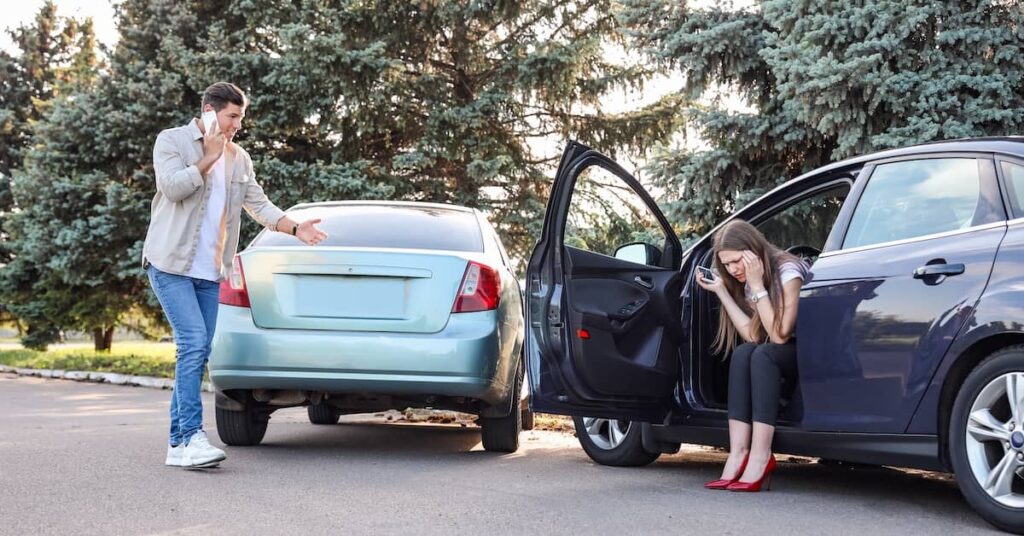


Colorado car accident fault is determined on the basis of negligence. If a motorist causes an accident as a result of speeding, distracted driving, or reckless driving, they may be held liable for the damages you sustain.
Establishing fault and recovering compensation is not always a straightforward process. An experienced car accident lawyer in Colorado can investigate and gather evidence showing that the other driver was at fault.
At Burg Simpson, we have been advocating for car accident victims in Colorado for over 45 years. Our firm has recovered more than $2 billion in results.
To discuss your claim with our award-winning car accident lawyers, call us today at 303-792-5595 for a FREE and confidential case evaluation. We are proud to serve clients in Denver and throughout Colorado.
Colorado is an at-fault state, meaning the driver who causes the accident is legally responsible for the resulting injuries and damages. This is different from “no-fault” states, where drivers typically seek compensation solely from their own insurance regardless of who was at fault. Colorado used to have a no-fault system until the repeal of the Colorado Auto Accident Reparations Act in 2003.
In at-fault or tort states like Colorado, injured individuals are able to pursue compensation against negligent parties to recover damages for their losses. These may include:
To recover these and other damages, an accident victim must be able to clearly show how the accident was another party’s fault. Strong proof of negligence is required for the claim to succeed.
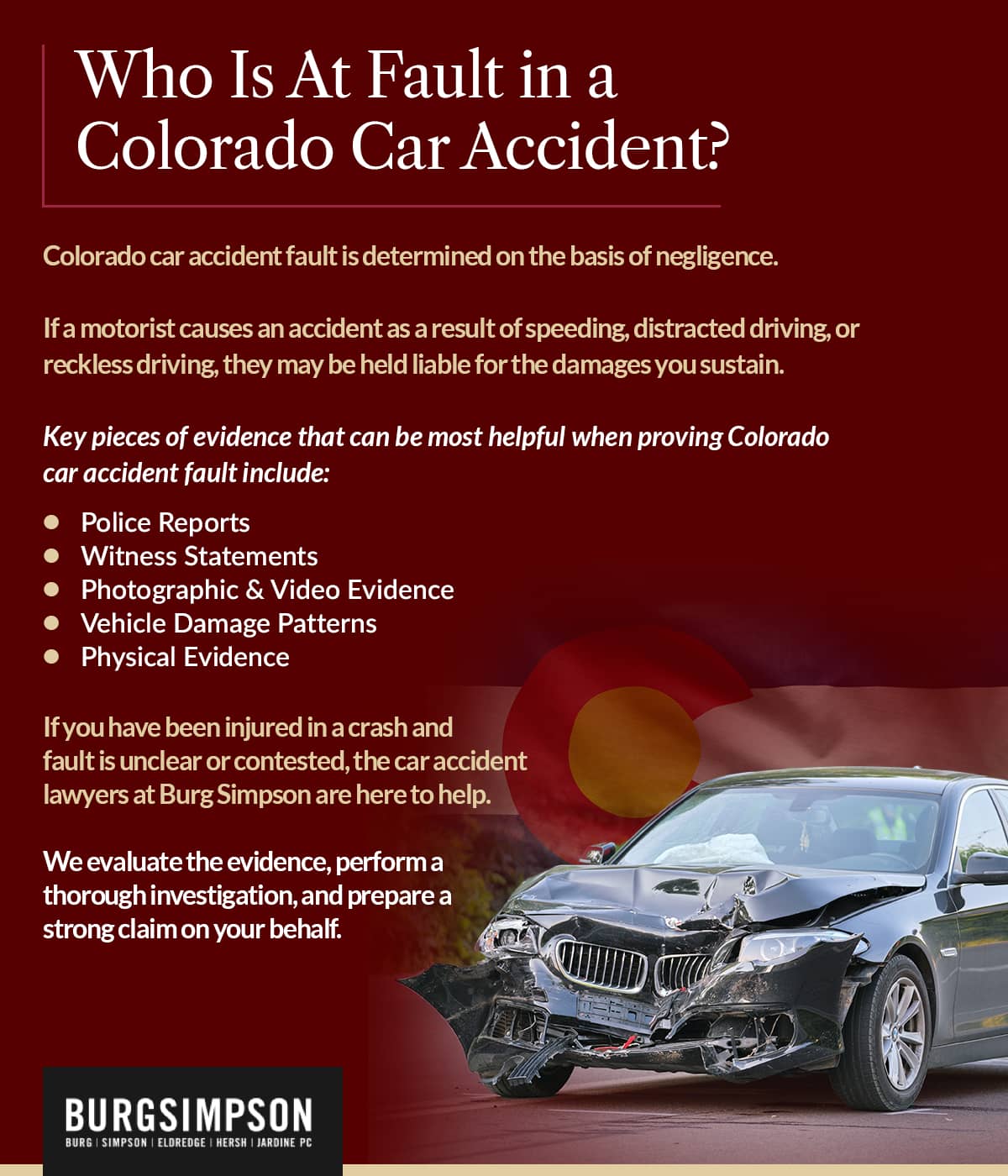
In some accidents, fault may be immediately apparent. For example: a driver runs a red light and collides with another vehicle, or a distracted driver rear-ends the vehicle in front of them.
These are just examples; Colorado car accident fault is not always so clear-cut. An experienced attorney may need to examine police reports, witness statements, physical evidence, and damage patterns to help determine liability. In some situations, accident reconstruction experts can also help to analyze technical data and evidence to clarify disputes around fault.
The important thing to keep in mind is that you should never simply accept someone else’s word for who is at fault — especially when that word comes from an insurance company.
When a driver is found to be at fault for an accident, they (or, in most cases, their insurer) are required to pay the appropriate amount of compensation to the injured party. Liability may also be shared among multiple parties.
For example, if a driver cuts someone off in traffic but the other driver was also speeding, then both drivers may share responsibility for the accident.
Colorado’s modified comparative negligence law provides a framework for these situations. You are allowed to recover compensation for damages provided you are less than 50% at fault for the accident. The amount of compensation you can recover is reduced by the percentage you are deemed to be at fault.
For example:
This dynamic can complicate negotiations with insurers. Hiring a knowledgeable car accident lawyer is vital for protecting your rights and negotiating the best settlement.
Under Colorado law, drivers making a left turn are required to yield to oncoming traffic. The driver traveling straight has the right of way, meaning left-turn drivers are often found at fault for accidents.
If the driver going straight was speeding, distracted, or violating traffic laws, then liability may be reversed or shared between both drivers. Ultimately, each collision must be assessed individually to take all factors into consideration, including:
Building a strong claim against a left-turning driver will still require strong evidence such as: video footage, witness statements, and reconstruction of the accident. Fault should never be assumed, and you should always expect to need evidence to prove the other party’s negligence.
Insurance adjusters rely on the available evidence, including photographs, witness statements, and the police report, to decide who is at fault. They also use internal guidelines and fault charts to help determine liability.
What is important to understand is that their goal is not to be objective. They will look for any opportunity to deny liability or assign shared fault as a means of limiting how much compensation they have to pay out.
This is why it is so important to secure legal representation. Having a capable car accident attorney on your side ensures that the insurance company’s assessments are fair and accurate and not influenced by their own financial interests.
Every car accident is unique, so the evidence available can change depending on the circumstances. Some of the key pieces of evidence that can be most helpful when proving Colorado car accident fault include:
More technical evidence may be needed for cases involving semi-truck accidents. GPS data, phone records, and other forms of evidence can help to establish the liability of multiple parties in these complex claims.
The steps you take immediately following a car accident can be critical for both the viability of your claim and your well-being. Do your best to complete at least the following:
If the other driver’s insurer tries to contact you, we strongly advise against complying with requests to make a recorded statement or give them access to your medical records. These requests may seem innocent, but they are usually made in an attempt to undermine your claim.
If you have been injured in a crash and fault is unclear or contested, the car accident lawyers at Burg Simpson are here to help. We evaluate the evidence, perform a thorough investigation, and prepare a strong claim on your behalf.
By combining our local experience and national resources, we are able to guide injured individuals through the fault determination process. Our attorneys protect your rights at every step and help you pursue the compensation you need and deserve.
To schedule your FREE case review with one of our car accident attorneys, call Burg Simpson at 303-792-5595 today. We are proud to serve clients from all over Colorado, including Denver, Colorado Springs, Fort Morgan, and Grand Junction.