




 Previous Article
Previous Article
Previous Article

Birth Injury vs. Birth Defect: Do You Have a Case?
June 1, 2026 | 10 min read
Share:


The birth of a child should be a joyous day for you and your family. Unfortunately, childbirth can be risky for mom and baby. Knowing the difference between a birth injury and a birth defect is crucial not only for understanding your legal rights, but recognizing the prognosis and challenges your child may face.
Burg Simpson can address the question of birth injury vs. birth defect and discuss your right to make a claim. We handle these cases with the utmost compassion, providing you with support and guidance as well as strong advocacy.
If your child was harmed as a result of medical negligence, our Denver birth injury lawyers can prepare a strong claim on your behalf. We account for the cost of your child’s care and future expenses, as well as future hardships.
Call Burg Simpson at 303-792-5595 today for a FREE and confidential case evaluation. Our firm has recovered millions of dollars for families in birth injury claims.
What Is a Birth Injury?
A birth injury is harm suffered by a baby just before, during, or shortly after labor and delivery. They often occur due to unmanaged complications, physical trauma, or lack of oxygen. In many cases, the full extent of the birth injury may not be apparent until there are issues with the child’s development.
Birth injuries are often preventable. You may be able to bring a medical malpractice claim against healthcare professionals whose negligence harmed your child.
Common Types of Birth Injuries
Most birth injuries are relatively mild, such as bruising of the face or swelling of the scalp. Other birth injuries are catastrophic, altering the course of a child’s life forever.
Common types of birth injuries include:
- Brachial plexus injuries: The brachial plexus is a group of nerves that connect the spinal cord to the shoulders, arms, and hands. Injury to the brachial plexus may result in Erb’s palsy (diminished use of an arm) or Klumpke’s palsy (diminished use of a hand).
- Cerebral palsy: This complex neurological disorder can affect mobility, intellect, speech, and motor skills. Causes of cerebral palsy include oxygen deprivation, brain trauma, and infection.
- Hypoxic-ischemic encephalopathy (HIE): Neonatal HIE occurs when a baby’s brain is deprived of oxygen just prior to birth, during labor, or shortly after delivery. This is a medical emergency that requires swift intervention to minimize permanent brain damage.
- Cephalohematoma: A cephalohematoma is a buildup of blood between the skull bone and the membrane covering the skull (the periosteum). It is often caused by forceps or vacuum devices. The injury is usually minor and resolves on its own, but it needs to be monitored for signs of jaundice. Untreated jaundice can give way to kernicterus, a condition that may lead to brain damage.
- Intracranial bleeding: Physical trauma to the brain during labor and delivery can leave your child with a brain injury. Steps need to be taken at once to control the bleeding.
- Bone fractures: Neonatal fractures may occur in difficult deliveries, with the collarbone or clavicle the most likely bone to break. Fractures often heal on their own, but conditions like shoulder dystocia can lead to more complex injuries.
- Facial nerve injuries: Injuries to the nerves in the face may be temporary or permanent. Severe cases can result in paralysis of the facial muscles.
- Spinal cord injuries: Breech delivery, shoulder dystocia, and misuse of medical instruments may damage the baby’s spinal cord. Spinal cord injuries at birth can result in paralysis from the earliest moments of life.
The severity of a birth injury is not always apparent when a baby is born. If you notice worrying symptoms or your child seems to be in distress, it is important to seek medical care as soon as possible.
Common Causes of Birth Injuries
Potential causes of a birth injury include:
- Failure to recognize fetal distress: Monitors in the delivery room should inform doctors and nurses if the baby’s oxygen is low or the heart rate is abnormal. Errors in monitoring can cause these issues to go unnoticed and put the baby in danger.
- Delayed diagnosis of maternal conditions: Preeclampsia, gestational diabetes, and infections increase the likelihood of a birth injury. Misdiagnosis and failure to diagnose these conditions can have devastating consequences for the mother and the baby.
- Prolonged labor: A long and difficult delivery is more likely to cause physical trauma or deprive the baby of oxygen.
- Failure to induce labor or order a C-section: Medical professionals involved in labor need to make timely decisions about methods for moving the delivery along, such as administering medications and performing a cesarean section. Delays can prove costly for the baby’s well-being.
- Errors in the use of forceps and other equipment: Instrument-assisted deliveries can go wrong if the instruments are not used properly, potentially causing serious injury to the scalp, head, and face.
- Delays in ordering neonatal cooling for HIE: Neonatal cooling is the only proven therapy that helps reduce brain damage in babies with hypoxic-ischemic encephalopathy. Delays in getting the baby to a neonatal cooling facility put them at risk for cerebral palsy, seizures, and other serious complications.
You need to prove negligence on the part of a medical provider or the hospital to file a lawsuit for a birth injury. Proving this can be difficult, as the evidence is complex and often hard to obtain. A skilled birth injury lawyer can investigate how negligence led to your baby’s injury.
How Common Are Birth Injuries?
Significant birth injury is reported in 6–8 out of every 1,000 births. Approximately 21,000 to 28,000 babies suffer birth injuries every year in the United States. For these children and their families, the suffering can be unimaginable and the future may seem uncertain.
Your child is not a statistic, and your family should not have to face the consequences of medical malpractice alone. Contact Burg Simpson today.
What Is a Birth Defect?
A birth defect (also known as a congenital anomaly) is a medical condition or abnormality that is present when the baby is born. Birth defects develop early in pregnancy, usually during the first trimester. When it comes to birth injury vs. birth defect, this is one of the biggest differences; birth injuries typically occur very late in pregnancy or when the baby is being delivered.
Some birth defects are detectable at prenatal screenings, while others are only apparent when the child is born. Because the condition occurs while the baby is developing in the womb, medical providers are generally not liable for birth defects.
Common Types of Birth Defects
As with birth injuries, birth defects can range from minor to catastrophic. Congenital anomalies may arise in multiple organs and bodily systems.
The most common types of birth defects include:
- Congenital heart defects: The most common type of birth defect, these are structural abnormalities in the heart. Surgical repair is often required.
- Musculoskeletal defects: Clubfoot is the most common example of musculoskeletal birth defects. This category also includes limb deficiencies and differences.
- Cleft lip and cleft palate: Another common birth defect, a cleft lip or palate occurs when the upper lip or roof of the mouth does not fully form.
- Down syndrome: Also known as trisomy 21, Down syndrome is a chromosomal defect characterized by intellectual disabilities, delays in development, and physical differences.
- Gastrointestinal defects: Intestinal blockages, abnormalities in the abdominal wall, and underdevelopment of the GI tract often need to be repaired surgically.
- Neural tube defects: The neural tube is the early precursor of the central nervous system during fetal development. Spina bifida (incomplete closure of the spine) can cause severe disability, while anencephaly (malformation of the brain and skull) is fatal.
Some birth defects are obvious when the baby is born, including cleft lift and palate, limb anomalies, and spina bifida. Others may be asymptomatic for years.
Common Causes of Birth Defects
Birth defects are often the result of genetic or environmental factors. They may also be caused by medical conditions affecting the mother. Sometimes the exact cause cannot be identified.
Potential causes of birth defects include:
- Genetic or chromosomal conditions: Many birth defects are the result of genetic mutations or chromosome differences. These may be inherited from one or both parents or arise spontaneously.
- Environmental exposure: Pregnant women are encouraged to avoid alcohol, smoking, and illicit drugs to avoid birth defects. Some prescription medications can be hazardous to the developing fetus as well. Prenatal exposure to mercury, lead, and other toxins is also associated with birth defects.
- Maternal health: Infections such as cytomegalovirus, rubella, and toxoplasmosis may be passed from mother to baby in the first trimester. Maternal obesity and advanced age also increase the risk of birth defects.
Failure to advise an expectant mother of risks to her unborn baby may be considered medical negligence. If your baby was born with a birth defect and your doctor did not advise you of potential risk factors, you should seek legal advice.
How Common Are Birth Defects?
Birth defects are more common than birth injuries. Every year, approximately 1 in 33 babies is born with a birth defect. Approximately 109,000 babies in the United States are born with birth defects each year.
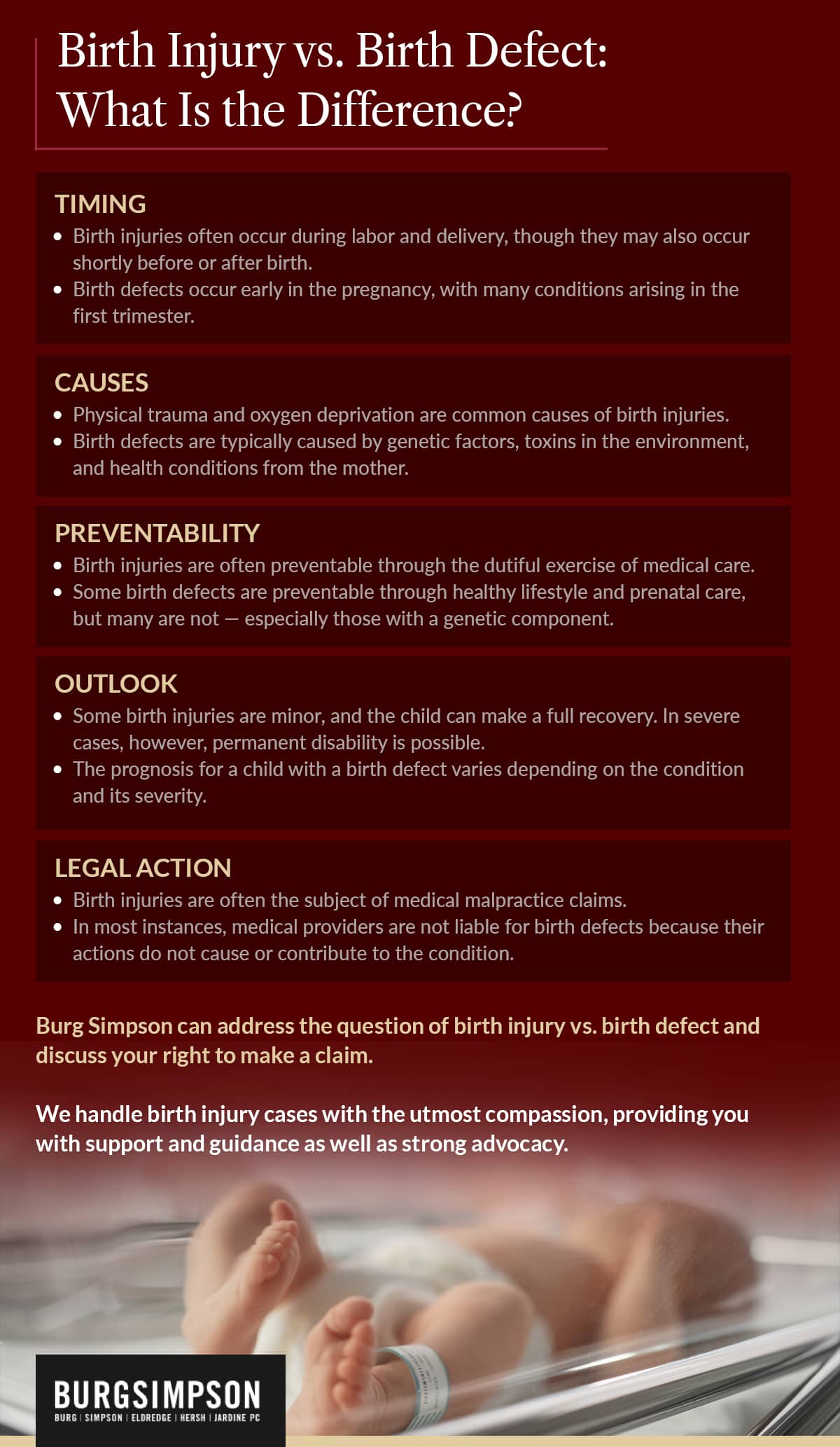
Birth Injury vs. Birth Defect: Key Differences
A birth injury or a birth defect can impact a child’s development and lead to permanent disability. However, there are important differences between these conditions that parents need to know.
- Timing
- Birth injuries often occur during labor and delivery, though they may also occur shortly before or after birth.
- Birth defects occur early in the pregnancy, with many conditions arising in the first trimester.
- Causes
- Physical trauma and oxygen deprivation are common causes of birth injuries. These may be grounds for a medical malpractice lawsuit.
- Birth defects are typically caused by genetic factors, toxins in the environment, and health conditions from the mother.
- Preventability
- Birth injuries are often preventable through the dutiful exercise of medical care.
- Some birth defects are preventable through healthy lifestyle and prenatal care, but many are not — especially those with a genetic component.
- Legal action
- Birth injuries are often the subject of medical malpractice claims.
- In most instances, medical providers are not liable for birth defects because their actions do not cause or contribute to the condition.
- Outlook
- Some birth injuries are minor, and the child can make a full recovery. In severe cases, however, permanent disability is possible.
- The prognosis for a child with a birth defect varies depending on the condition and its severity. Some conditions are manageable through medication and lifestyle adjustments, some require surgical correction, and some require lifelong treatment and support
How Long Do I Have to Make a Birth Injury Claim in Colorado?
Birth injury claims in Colorado must be brought within the statute of limitations. This is the legal time limit for filing a lawsuit. If you wait too long and the statute expires, you will forfeit the right to claim compensation.
The general time limit for Colorado medical malpractice claims is 2 years. However, if a child is injured prior to their 6th birthday, parents have until the child turns 8 to take legal action on their behalf.
Often, this gives parents additional time to understand their child’s condition and gather evidence of a healthcare practitioner’s negligence. A knowledgeable birth injury lawyer can investigate, collect evidence on your behalf, and ensure that your claim is filed within the deadline.
Do I Have a Case?
You may have a viable case if you can prove that medical negligence caused your child’s birth injury.
Key components of a successful birth injury claim include:
- Duty of care: For doctors, nurses, midwives, and other providers, the duty of care is a legal obligation to provide medical care according to accepted standards during labor and delivery.
- Breach: A breach is a failure to uphold the duty of care. Examples include negligent monitoring for fetal distress, misuse of instruments, etc.
- Causation: The evidence needs to show that the actions (or inaction) of delivery room staff caused your baby’s injury.
- Damages: You need to present evidence of the damages you, your child, and your family have sustained.
Most birth defects are not the result of medical negligence, so you likely do not have a case against the doctor or hospital. However, companies have faced litigation from families alleging that defective products and negligent industrial practices led to toxic exposure during pregnancy that resulted in birth defects.
Burg Simpson can explore your legal options for FREE.
What Damages Can I Recover for a Birth Injury?
You and your family may be entitled to substantial compensation if your baby was harmed due to medical malpractice. Damages may include your losses to date, as well as any burdens you will face in the future.
Potential damages in a Denver birth injury claim include:
- Medical expenses for the baby’s (and the mother’s) injury
- Therapy and rehabilitation costs
- Future medical expenses
- Reduced earning capacity for the child
- Lost wages, if one or both parents need to stop working to care for the child
- The cost of mobility aids, medical devices, and other equipment
- Modifications to the family home and vehicle
- In-home healthcare and domestic assistance
- Pain and suffering for the child
- Emotional anguish for the child and parents
- Loss of enjoyment of life
Calculating damages can be difficult when your baby is facing a lifetime of special needs and unique challenges. Having experienced legal counsel is vital for determining the full compensation you are due and maximizing your settlement or trial award.
Learn How Burg Simpson Can Help
Birth injury vs. birth defect is a difficult and emotional issue. Many families’ hopes for their children are dashed by negligence in the delivery room. Injuries may be diagnosed shortly after the baby is born, or years in the future amid everyday struggles and delays in reaching developmental milestones.
You may have a claim if your child suffered a preventable birth injury. For 50 years, Burg Simpson has been a voice for those who were harmed by the negligence and wrongdoing of others. We have in-depth experience with complex medical malpractice claims, including cases where a child is injured as they enter the world.
For a FREE and confidential case review, call 303-792-5595 today. Burg Simpson represents clients in birth injury cases throughout Colorado from our office in the Denver area.
Share:
More Articles For You

May 14, 2026 | 8 min read
View Article >>